

Cellular IoT has a reputation for being hard to get into.
The space looks enormous, the terminology is inconsistent, and a lot of the most talked about use cases sit at the far end of the spectrum — think smart cities, industrial transformation, predictive infrastructure.
All compelling on a conference stage, hard to turn into something you can sell next week.
When opportunity is framed at that scale, it becomes abstract. And when it’s abstract, it’s hard to see where to start, or how to build something repeatable.
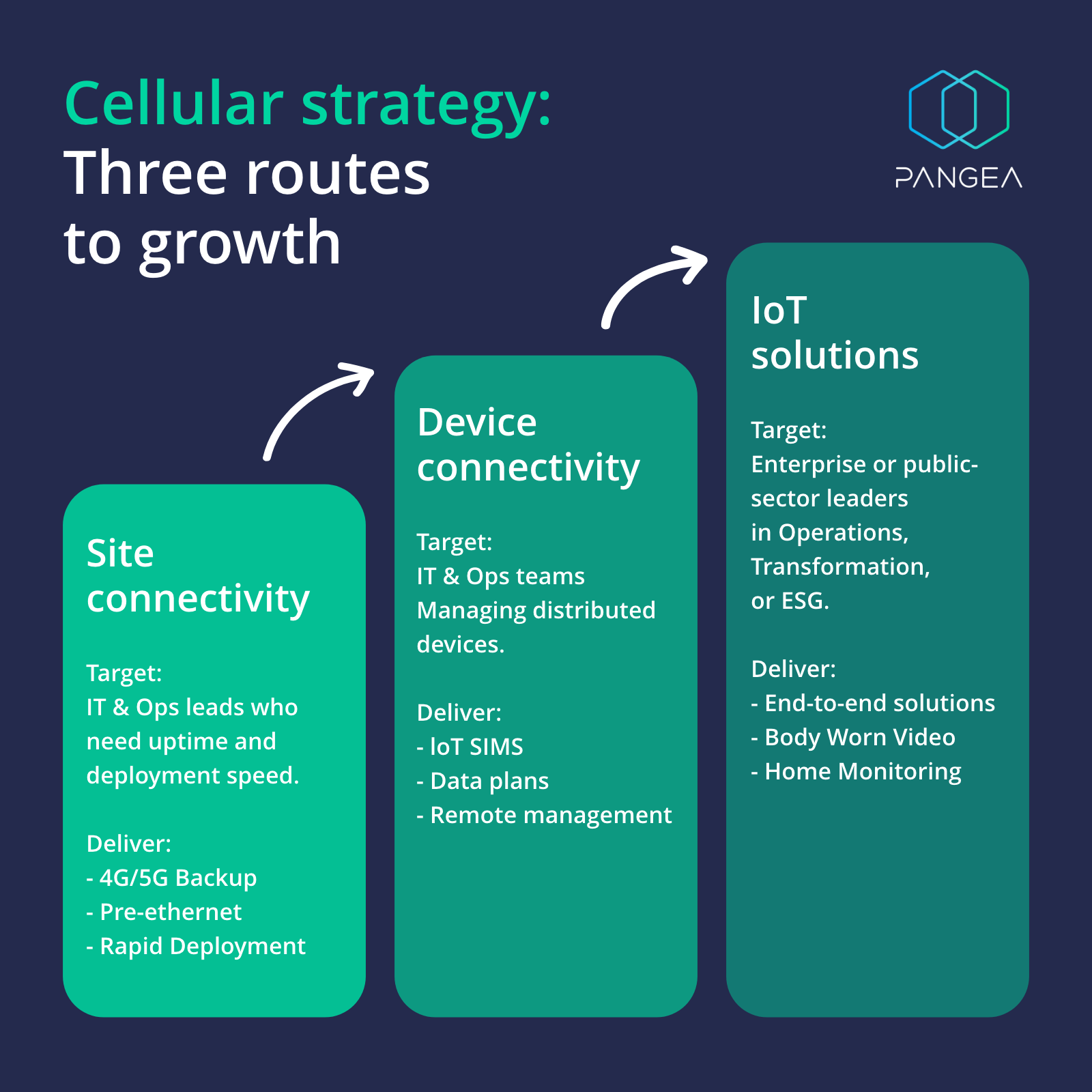
In reality, it’s far simpler than the market makes it look. Underneath all the applications and jargon, cellular contributes to reseller and MSP growth in three distinct ways:
Cellular used to protect and strengthen fixed-line services, with backup as the primary lever.
Managing estates of distributed devices with the visibility and control to run them profitably at scale.
Connectivity embedded inside outcome-led services for buyers who are procuring a result, not a connection.
Each route has a different buyer, a different service requirement, and a different commercial upside when it's built deliberately.
Getting clear on which one you're in — and what it actually requires — is what turns cellular from an overwhelming opportunity into a focused one.
Site connectivity is where most resellers and MSPs have the most immediate, underleveraged opportunity.
The core use case is backup — cellular failover that keeps a site online when the fixed line goes down.
Pre-ethernet and rapid deployment sit alongside it as distinct tools for specific moments: pre-ethernet bridges the gap while a circuit is being installed, rapid deployment gets a temporary or remote site online at short notice. Both are worth having in the conversation.
But backup is where the commercial case is clearest and the sales motion is most repeatable.
The buyer is an IT Manager, Network Lead, or Operations Manager. Their job is uptime. They've either been burned by a fixed-line outage already, or they're responsible enough to want protection before it happens.
Either way, they don't need convincing that resilience matters — they need to see that you've designed for it.
When backup is embedded as standard — designed into fixed-line services rather than offered as an optional extra — the effect on the business is direct.
Fixed-line deals become easier to close because the service is visibly more complete. SLA exposure from outages drops. Customers who've experienced downtime elsewhere, and most have, recognise quickly when a provider has thought about what happens when things fail.
That recognition compounds over time. It makes renewals less contentious, referrals more likely, and the relationship stickier. A customer who's never had a site go down under your service has a very different conversation at contract review than one who's had to call in an outage twice.
Backup underperforms when it's sold as optional.
The conversation that kills it sounds like: "we can add cellular failover if you want, it's a bit extra." That frames it as insurance against a problem the customer may not believe they have.
The framing that moves it is different: backup is part of how you design connectivity. It's how you remove the single point of failure behind operations that run on fixed-line every day. When sales teams treat it that way, it stops being a negotiation and starts being how the service works.
Fixed-line and SD-WAN deals close more cleanly because the service is more complete. Outage-related escalations and SLA credits drop. The backup conversation stops being a line item customers push back on and becomes a reason they stay — because no other provider in the conversation is offering the same level of designed-in resilience.
is the margin you built into your last ten fixed-line deals still there at the end of delivery? If outage escalations and reactive fixes are absorbing it, the lever is usually how backup is being positioned, not whether the product is right.
Device connectivity attracts attention because the revenue mechanics are legible: more devices under management, more recurring revenue, compounding as the estate grows. And for resellers who build it properly it's one of the more durable growth models in the channel.
The mistake most partners make is treating it as a natural extension of site connectivity — more cellular to more customers — when it's a fundamentally different service.
Where site connectivity is about keeping a location online, device connectivity is about managing a population of assets distributed across many locations — CCTV cameras, EPOS terminals, access control, kiosks, digital signage — so that they can be operated predictably over time.
The buyer is still IT or Operations, but their question has changed. It's no longer whether the site's connected. It's whether the estate can be managed, optimised, and accounted for as it scales.
Device connectivity scales most reliably when it builds on relationships you already have and assets those customers already treat as their responsibility.
The estates that work best as early plays here — CCTV, POS, access control — aren't thought of as IoT by the people managing them. They're operational infrastructure, expected to work and expected to be supported.
That matters commercially because it means you don't have to introduce a new buying category. The conversation starts from whether the existing setup is doing its job properly — whether the connectivity is right for how the devices are actually used, whether the teams managing it have enough visibility to stay ahead of problems.
Estate reviews and audits land well here because they feel like diligence. You're assessing what they've already bought, not pitching something new.
The standard argument for control in device connectivity is defensive: fix problems faster, reduce escalations, protect the customer relationship. That's true and worth making. The commercial case for control is equally strong and gets less attention.
When you have genuine control over an estate you can optimise how the service performs and what it costs.
Data pooling across a large estate means individual devices don't burn through allocations inefficiently; surplus from low-usage devices covers high-usage ones, and the overall cost of the estate comes down.
Visibility into usage patterns and alerts let you catch SIM overspend or anomalies before they show up on a customer invoice as a surprise.
The ability to adjust tariffs and profiles remotely means you're not locked into a commercial model that made sense at deployment but no longer fits how the estate actually behaves six months in.
That compounding effect is what makes device connectivity genuinely attractive at scale. An estate of 500 devices managed with this level of control doesn't just generate more revenue than an estate of 100 — it generates it more efficiently.
Support costs per device fall as the model matures. Margin per SIM improves as pooling and profile management tighten the commercial fit. The estate becomes more profitable to run as it grows, not less.
Imagine a retail customer with 200 EPOS terminals across 40 sites. Three drop off overnight. The store manager calls in the morning. You can see in the portal that the SIMs are connected — but you can't do anything without escalating to your connectivity provider. By the time they respond, the customer has called support twice and started asking whether they should be looking elsewhere.
That scenario isn't unusual. It's the default experience on platforms built for the provider's operational efficiency rather than the partner's ownership.
Visibility into what's happening is cheap to provide. The ability to act on it and resolve without escalating — requires a fundamentally different architecture and a provider willing to hand control to the partner rather than retain it. Most don't, because control and lock-in are related.
Recurring revenue grows as devices are added under the same model without proportional growth in support overhead. Data pooling reduces the cost of running the estate as it scales. Usage visibility lets you catch commercial mismatches before they become customer issues. And the margin per device improves over time — because the platform is doing commercial work, not just operational work.
if this estate doubled in size, would your support load and margin both scale — or would only one of them?
In IoT solutions, cellular isn't the service being sold — it's infrastructure inside one. The buyer is a senior operational or public-sector leader accountable for a defined outcome — compliance, efficiency, cost reduction, operational visibility. They're procuring a change programme, and connectivity is just one component of it.
That buyer evaluates everything differently. Uptime is assumed. What they want to know is whether the service will deliver what it was designed for, and who's accountable if it doesn't. Connectivity SLAs and portal access don't answer that question. A service model that owns the outcome does.
IoT solutions change the shape of a reseller's revenue in ways the other routes don't.
Contract values are higher because services are priced against outcomes rather than components. Relationships sit at a more senior level and tend to be longer in tenure — outcome buyers don't switch providers casually when the service is embedded in how their operation runs.
The positioning that comes with delivering measurable results to operational leaders opens doors that a connectivity conversation alone rarely reaches.
Partners who build this route deliberately — starting narrow and expanding only once the delivery model is proven — often describe it as the route that changes how they're perceived in their market. Being known for outcome delivery in a specific vertical attracts a different quality of inbound opportunity than being known for competitive SIM pricing.
Responsibility in Route 3 expands well beyond connectivity. Device lifecycle management, data integrity, reporting, governance, remediation — all of it sits inside the service.
When something underperforms, the conversation escalates immediately to who owns it. Partners who've designed their service model around that expectation build high-value, durable contracts. Partners who haven't find that each contract costs more to deliver than the last.
It’s why Route 3 rewards precision over breadth. The partners who make it work tend to start with one sector they understand operationally, one outcome with a clear owner on the customer side, and one service model they can deliver consistently before expanding.
Many enter alongside specialist partners who can provide the device, platform, analytics, and connectivity layer — that's usually the structurally sound approach, and it's not a compromise.
Contract values reflect outcomes rather than components, so margin is structurally stronger. Customer relationships sit at director or VP level and tend to be sticky — outcome buyers don't exit easily when the service is working. Being associated with a specific vertical outcome builds a reputation that attracts similar opportunities without requiring the same sales effort to open them.
if this service underperforms at month six, who carries the consequence — and are you equipped to manage that across multiple customers without it eroding the margin that made the contract worth winning?

The commercial case for treating these routes distinctly isn't complicated. It's just easy to underestimate when each one gets handled reactively rather than built deliberately.
Site connectivity, done properly, makes your fixed-line and SD-WAN business more profitable to deliver. Delivery certainty removes the cost of exceptions — the escalations, credits, and support overhead that get absorbed when outages aren't designed out. It also makes those propositions easier to sell, because customers who've experienced unreliable services elsewhere recognise quickly when a provider has thought about failure.
Device connectivity, built on the right control infrastructure, compounds. The first hundred devices under management are harder than the next four hundred, because the model — the pooling, the profile management, the commercial structure — is doing more of the work as the estate grows. That's what separates partners who've built a recurring revenue engine from those who've built a recurring support overhead.
IoT solutions change who you are in your market. Partners who've delivered one or two outcome contracts in a vertical they understand don't just have better revenue — they have a different kind of conversation with new customers. The proof is in what they've already delivered, not in what they're promising.
The risk in each route is real — and this piece hasn't understated it. But the risk of building these routes properly is bounded and manageable. The risk of pursuing them without the right foundation accumulates gradually, in eroding margins and customer relationships that become harder to defend than they looked when the deal was signed.
The commercial upside of getting it right compounds in ways that feel obvious in retrospect.
Before committing to a new route, the most useful exercise is to audit what's already in front of you — because in almost every case, the opportunity is closer than it looks.
For site connectivity: pull the last twelve months of fixed-line installs and count how many had a delay, an escalation, or a reactive fix — a circuit that didn't arrive on time, a site that couldn't open, a live service that went down. That number is the size of the problem cellular is already solving informally, whether through pre-ethernet, rapid deployment, or backup. If it's more than a handful, the case for making all three standard writes itself.
For device connectivity: look at which customers already expect you to support devices rather than just connections. CCTV, EPOS, access control — if those conversations are landing in your support queue already, the estate is there. The question is whether you're managing it deliberately or just absorbing it.
For IoT solutions: the signal isn't customer demand — customers rarely ask for it by name. It's whether you have a vertical where you understand the operational context well enough to define what a good outcome looks like and stand behind it. One vertical, one outcome, one customer willing to be a reference. That's the entry point.
Plenty of partners aren't operating in device connectivity or IoT solutions yet, and that's a reasonable place to be. The commercial risk isn't in moving carefully — it's in committing to a route the business isn't structured to deliver, and absorbing the cost of that gap twelve months in when the customer relationship is already under pressure.
The reason most cellular providers only hand partners a SIM, a rate card, and a portal is that it's the most efficient way to run a high-volume connectivity business. It's not designed to help partners build theirs.
We work exclusively through partners, and that means our commercial interest is aligned with yours in a way that a provider selling direct or through volume aggregation structurally can't be.
When your margins improve, when your estate management gets more efficient, when your customers renew without a fight — that's what makes the relationship work for us.
In practical terms: control in our platform is built around partner ownership. You can act when you're accountable, rather than waiting for someone else's queue. The same control that protects you operationally is what lets you run estates more efficiently commercially: catching overspend before it lands on the customer, tightening the commercial model as the estate grows.
When you're ready to move between routes, you're building on what's already working. The commercial models, enablement, and support structures are designed to make each route repeatable — so growth compounds rather than requiring you to rebuild delivery every time you take on a new type of customer.


_white.svg)


